
Call us now :07313727211
 Send Inquiry
 Send Inquiry
Pocket Pentrometer
Price 10000.0 INR/ Piece
MOQ : 1 Piece
Pocket Pentrometer Specification
- Equipment Type
- Soil Pocket Penetrometer
- Application
- Determination of unconfined compressive strength of cohesive soils
- Hardness
- Corrosion resistant body
- Measuring Range
- 0 to 4.5 tons/sq.ft. (0 to 450 kPa)
- Max Height
- Approx. 160 mm
- Display Type
- Analog scale
- Power Supply
- Not required (Mechanical)
- Number of Specimens
- Single specimen at a time
- Features
- Compact, portable, easy to use, direct reading, stainless steel piston
- Accuracy
- ±0.1 TSF
- Response Time
- Immediate
- Specimen Size
- Soil sample surface
- Mounting Type
- Hand held
- Humidity
- 0% - 90% RH (non-condensing)
- Automation Grade
- Manual
- Test Range
- 0 - 4.5 tons/sq.ft. (0 - 4.5 TSF)
- Temperature
- 0°C to 50°C operating range
- Resolution
- 0.1 TSF
- Usage
- Field and laboratory use
- Capacity
- 4.5 TSF
- Machine Weight
- Approx. 100 grams
- Test Speed
- Manual operation
- Control Mode
- Manual
- Depth Indicator
- Engraved graduation marks
- Piston Diameter
- 6.4 mm (0.25 inch)
- Body Finish
- Satin chrome
- Included Accessories
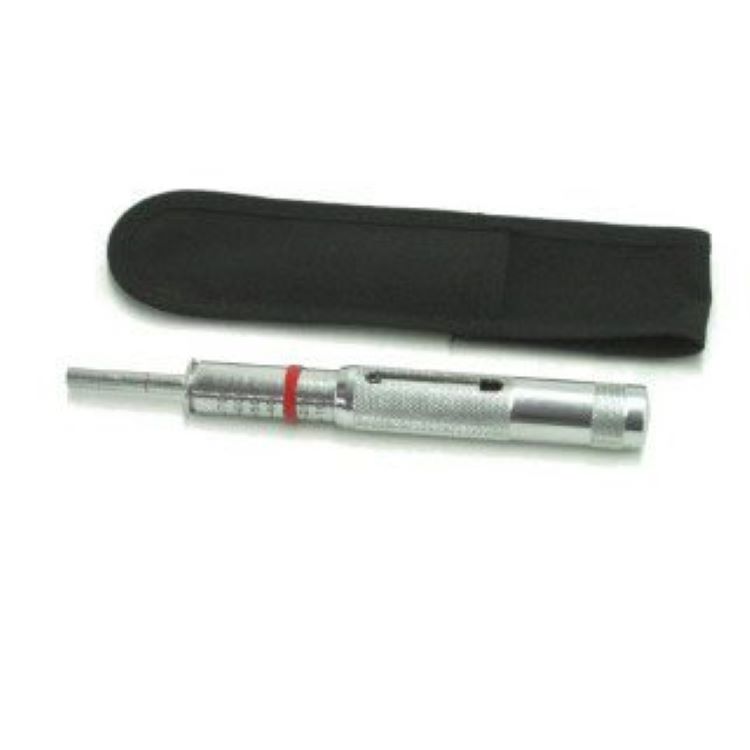
- Carrying case, instruction manual
- Scale Graduation
- 0.25 TSF
- Material
- Stainless steel housing
- Safety
- Ergonomic grip for safe use
Pocket Pentrometer Trade Information
- Minimum Order Quantity
- 1 Piece
- FOB Port
- subitek
- Payment Terms
- Cash Advance (CA), Cash in Advance (CID)
- Supply Ability
- 1 Piece Per Day
- Delivery Time
- 1 Days
- Sample Available
- No
- Packaging Details
- cotton box
- Main Export Market(s)
- Asia, Africa
- Main Domestic Market
- Assam, Delhi, Dadra and Nagar Haveli, Andaman and Nicobar Islands, Arunachal Pradesh, Tamil Nadu, West Bengal, Mizoram, Daman and Diu, Goa, Jharkhand, Tripura, All India, South India, Central India, West India, North India, East India, Gujarat, Karnataka, Kerala, Lakshadweep, Bihar, Uttarakhand, Meghalaya, Manipur, Andhra Pradesh, Chandigarh, Punjab, Chhattisgarh, Haryana, Odisha, Himachal Pradesh, Jammu and Kashmir, Madhya Pradesh, Maharashtra, Nagaland, Rajasthan, Sikkim, Telangana, Pondicherry, Uttar Pradesh
About Pocket Pentrometer
Specification:
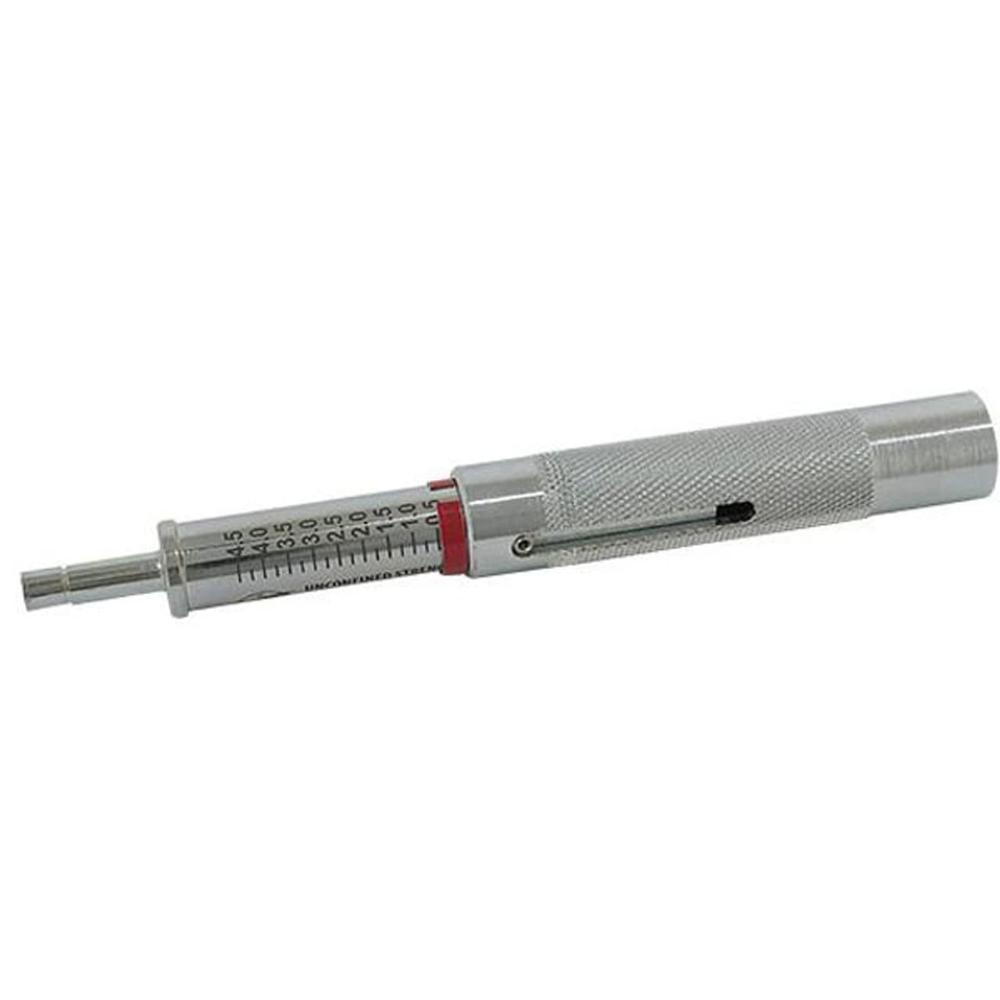
It consists of a light weight barrel assembly with a polished and ground steel loading piston plunger. A direct reading scale is engraved on the piston barrel and indicates load in kg. / sq. cm. A maximum load indicator ring is provided on the penetration plunger. The calibrated spring is heat treated and plated for rust resistance. The barrel diameter is 20mm and the length 150mm. Supplied with carrying case.
A typical pocket penetrometer spec includes a 1/4-inch (6.4 mm) diameter spring-loaded piston, a direct-reading scale for unconfined compressive strength in tons/sq. ft. and kg/cm, and a slip ring indicator to hold the reading. Key specifications also include a calibrated depth groove, rust-resistant construction, a carrying case, and an optional adapter foot to increase the piston area for testing very soft soils.
Key Components & Specifications
-
A calibrated 1/4-inch (6.4 mm) diameter piston, often made of stainless steel, that is pushed into the soil.
-
A marking on the piston that serves as a guide for insertion depth, indicating when the 1/4-inch penetration has been achieved.
-
Located on the piston's barrel, this scale provides an approximate measurement of the soil's unconfined compressive strength.
-
A slip ring that travels with the piston and remains in place after the piston is withdrawn, displaying the peak load reading.
-
A spring mechanism within the penetrometer that compresses under the force exerted by the soil.
-
A larger accessory that increases the effective piston area by 16 times, allowing for more accurate readings in very soft or fluid soils.
-
The device is typically made of stainless steel or features plating to resist rust and ensure durability.
Primary Applications
-
Used in geotechnical engineering to quickly classify the consistency and strength of cohesive soils in the field.
-
Measures the approximate shear strength and unconfined compressive strength (UCS) of soil.
-
Suitable for both rapid field testing and laboratory analysis of soil samples.
Reliable Soil Testing in Your Hand
Designed for both field and laboratory conditions, the Pocket Penetrometer allows quick determination of unconfined compressive strength for cohesive soils. Manual operation and robust stainless steel construction make it suitable for rugged use, while its compact design ensures portability. This tool is indispensable for soil engineers, geotechnicians, and inspectors conducting on-site tests or sample evaluations.
Precision Engineering for Accurate Measurements
The device boasts a stainless steel piston with a 6.4 mm diameter, engraved depth graduation marks, and a high-contrast analog scale for direct readings. With an accuracy of 0.1 TSF and a resolution of 0.1 TSF, it guarantees dependable results. The ergonomic design and mechanical operation eliminate the need for batteries, ensuring consistent performance wherever you need reliable soil assessment.
FAQ's of Pocket Pentrometer:
Q: How is the Pocket Penetrometer used for soil testing?
A: To use the Pocket Penetrometer, press the stainless steel piston perpendicularly against the soil sample surface until it penetrates to the engraved depth mark (standard depth). The analog scale displays the unconfined compressive strength of the soil directly in tons per square foot (TSF) or kilopascals (kPa).Q: What soil types can be tested with this instrument?
A: This pocket penetrometer is specifically designed for assessing the unconfined compressive strength of cohesive soils, such as clays, by measuring the resistance offered when the piston is pressed into the soil sample.Q: When should I use a pocket penetrometer during a soil investigation?
A: Utilize the Pocket Penetrometer during site investigations, quality control in field and laboratory testing, excavation planning, and when quick strength estimations of cohesive soils are required on-site.Q: Where can the Pocket Penetrometer be effectively utilized?
A: The device can be used in the field for on-site assessments or in laboratories for sample analysis. Its wide operating temperature (0C to 50C) and humidity tolerance make it suitable for various environmental conditions found in India and beyond.Q: What is the process for reading measurements on the penetrometer?
A: Press the piston into the soil until it reaches the engraved depth indicator; then, read the value shown on the analog scale. Ensure you are operating on a smooth soil surface and using the device on a single specimen at a time for best accuracy.Q: What are the main benefits of the Pocket Penetrometer?
A: Key benefits include immediate readings, compact design for portability, ease of use, robust stainless steel construction for corrosion resistance, and suitability for both field and laboratory environments. No power supply is needed, ensuring reliability in all settings.Q: Is training required to operate the Pocket Penetrometer?
A: Minimal training is needed. Clear instructions are provided in the manual. Following the recommended procedure ensures accurate and reproducible results for soil compressive strength estimation.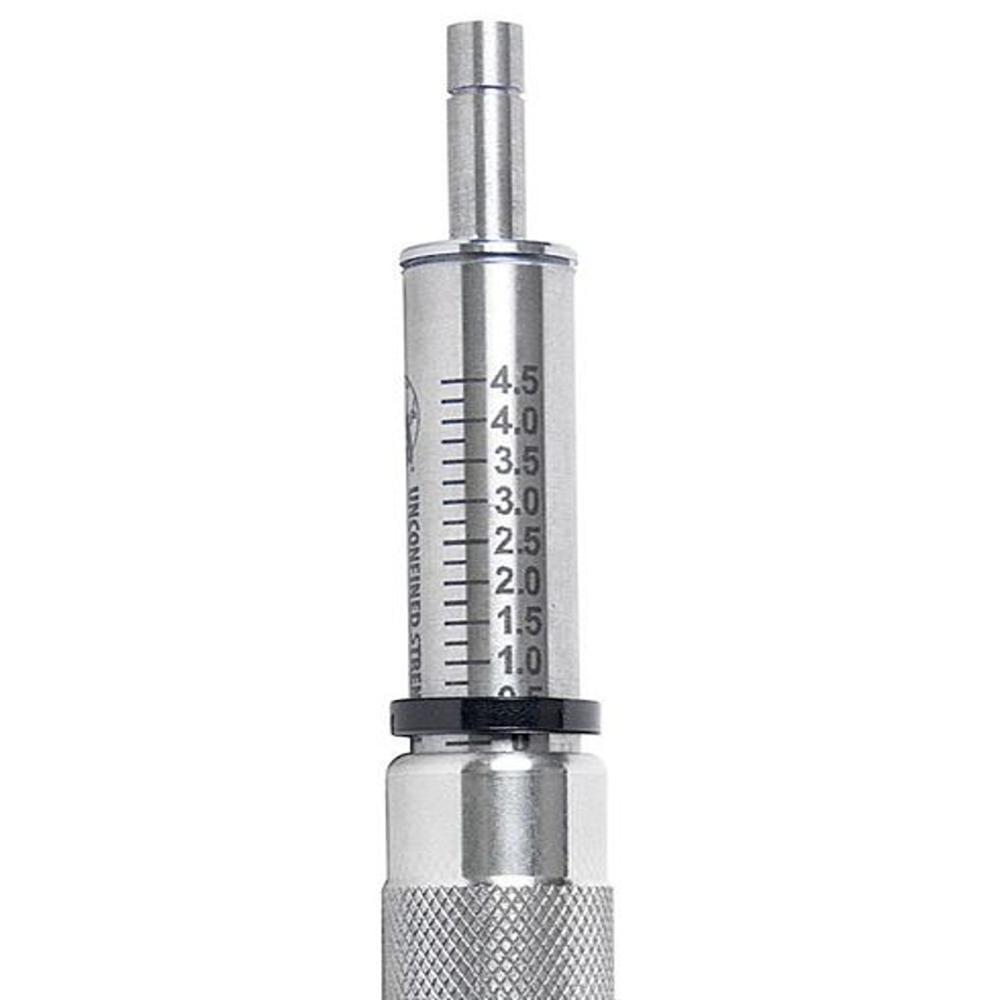
Tell us about your requirement

Price:
Quantity
Select Unit
- 50
- 100
- 200
- 250
- 500
- 1000+
Additional detail
Mobile number
Email

More Products in Soil Testing Equipment Category
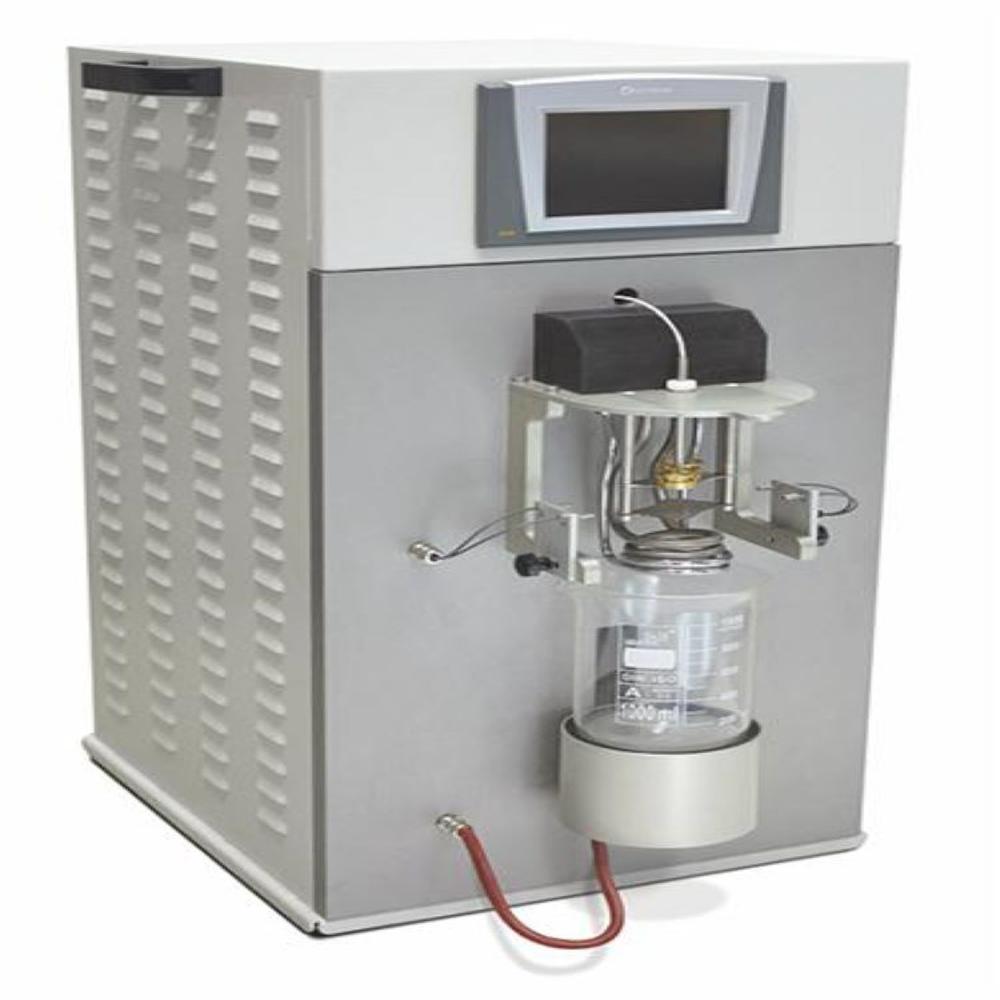
Automatic Ring and Ball Apparatus
Price 60000.0 INR / Piece
Minimum Order Quantity : 1 Piece
Usage : Laboratory Testing
Power Supply : 230 V AC 10%, 50 Hz, single phase
Features : Automatic stirring, digital timer, programmable temperature ramp, safety protection
Mounting Type : Bench Top
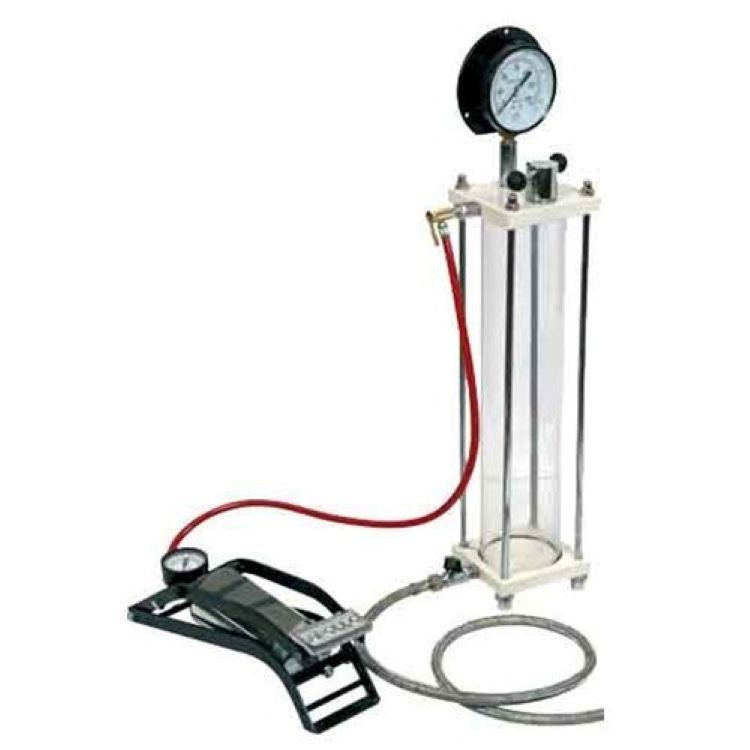
lateral pressure assembly
Price 10000.0 INR
Minimum Order Quantity : 1 Piece
Usage : Laboratory
Power Supply : 220 V AC, 50 Hz
Features : Corrosionresistant, Leakproof design, Easy calibration
Mounting Type : Benchtop
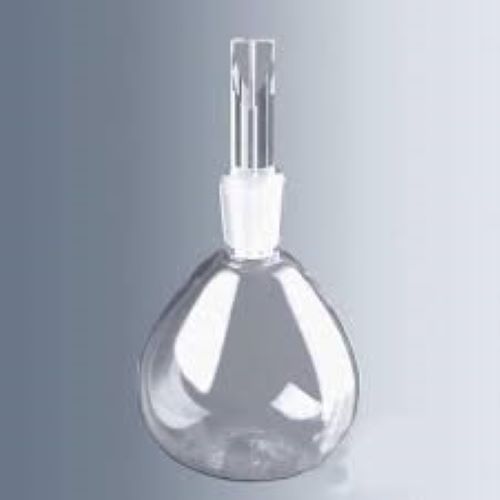
Den-sity Bottle (G-ay-Lu-ssac Type)
Price 500.0 INR / Piece
Minimum Order Quantity : 1 Piece
Usage : Laboratory, research, educational purposes
Features : Sturdy construction, clear labelling, ground glass stopper
Mounting Type : Benchtop
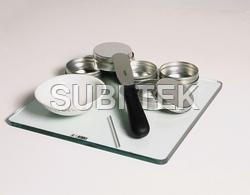
Plasti Limit Set Apparatus
Price 1800 INR / Piece
Minimum Order Quantity : 1 Piece
Usage : Industrial
Power Supply : AC

We are dealing in Coimbatore, Chennai and Tamilnadu.
 Send Inquiry
Our Products
- Concrete Testing Equipment
- Survey Lab Equipment
- Construction Equipment
- Concrete Testing Machine
- Soil Test Machine
- Survey Instrument
- Auto Level
- Cement Testing Machine
- Soil Testing Equipments
- Soil Testing Equipment
- Civil Engineering Lab Equipment
- Total Station
- Soil Test equipments
- Auto Level
- Concrete Highway Engineering lab
- Mechanical Engineering Lab Equipment
- Weighing Scale
- Laboratory Testing Equipment
- Workshop Trolleys
- Compression Testing Machine
- Water Testing Equipment
- Vertical Milling Machine
- Moulding Products
- CNC Machines
- Measuring Ruler
- Cylinder Carrier
- Core Cutting Machine
- Digital Measuring Machine
- Hydraulic Jack
- Drawing Instruments
- Fuel Testing Equipment
- Dynamics Lab Equipment
- Hydraulics and Fluid Mechanics Lab Equipment
- Heat Transfer Lab Equipment
- Scientific Equipment
- Surgical Equipment
- Hot Air Oven
- Impact Testing Machine
- Torsion Testers
- Bernoullis Theorem Apparatus
- Wooden Tripod
- Liquid Mercury
- Vibrating Table
- Material Testing Equipment
- Agriculture Equipment
- Waste Water Analysis

SF No. 189/1B1A, 191/3A1A1E, Sidco Private Industrial Estate, LIC Colony, Kurichi Pudhu Nagar, Kuruchi Housing,Coimbatore - 641021, Tamil Nadu, India

Mr Balamurugan C
(Manager)
Mobile :07313727211
 Send Inquiry
 Send SMS
Developed and Managed by Infocom Network Private Limited.
